Before you buy

17-fret or 19-fret tenor banjo?

Fret count is a label rather than a measurement, and two banjos both sold as 17-fret can differ by more than two inches of scale. The number that decides how the instrument feels and what strings it needs is the distance from nut to bridge. Here is what that distance actually changes, with the arithmetic.

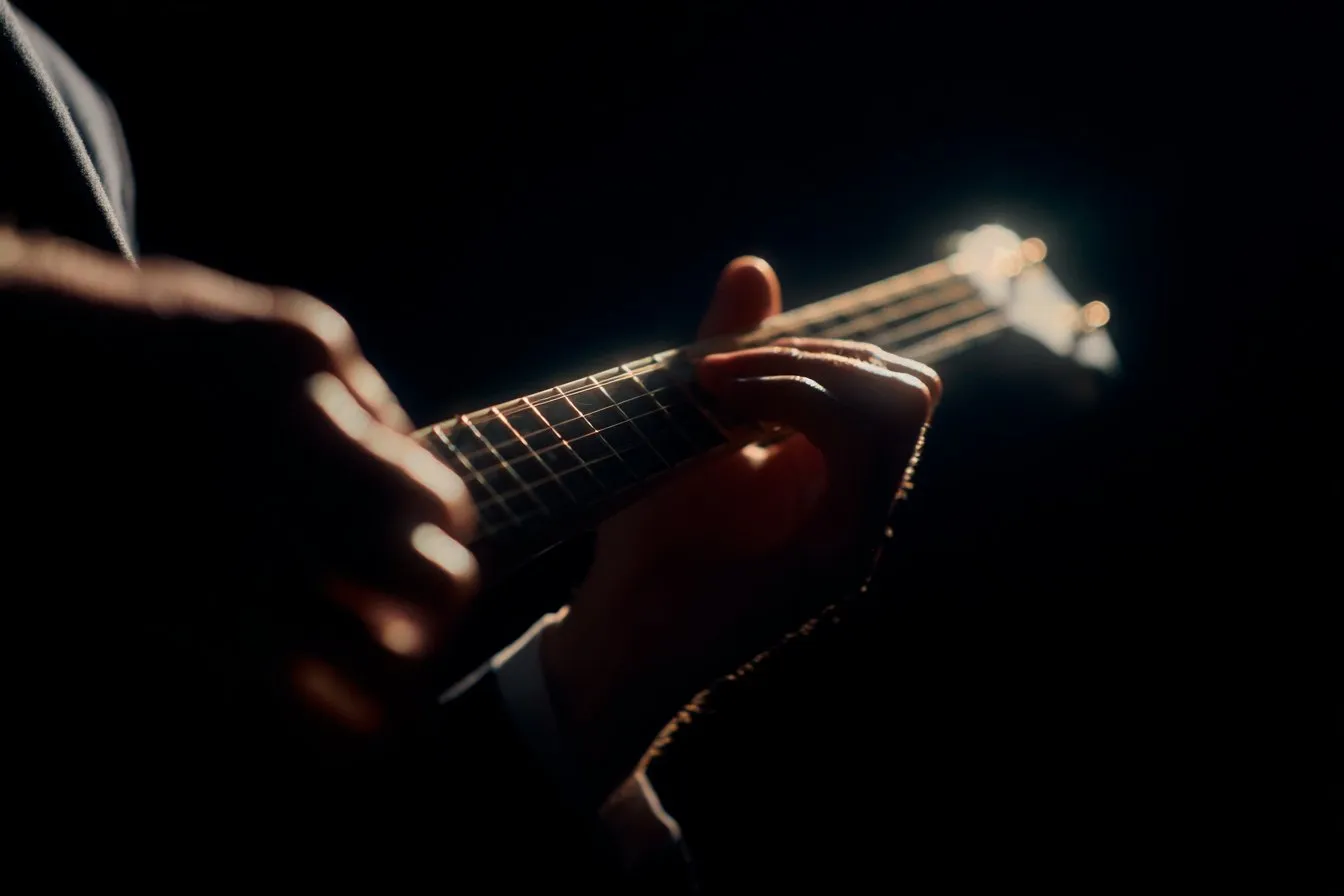
Close-up of a left hand fretting an Irish tenor banjo
Short answer
You are trading reach for tone
A 19-fret costs you
16% more stretch, everywhere on the neck
A 19-fret gives you
More volume, snappier attack, deeper bass
The number that matters
Scale length, not fret count
The two scales
17-fret runs 19 to 21.5in, 19-fret runs 22 to 23in
Who buys which
Professionals mostly 19-fret, beginners mostly 17-fret

Does fret count tell you the scale length?

No, and that is the trap. Everyone shopping for an Irish tenor banjo meets this question in the first ten minutes, and almost every answer treats 17-fret and 19-fret as if they were two fixed sizes. They are not. They are labels, and the sizes underneath them overlap and disagree.

One widely cited account puts the short-scale 17-fret at 20 to 21.5 inches and the long-scale 19-fret at 22 to 23. Discussion among players who own several puts the 17-fret lower, at 19 to 20 inches, and notes it can go shorter still. Those two accounts differ by more than two inches at the short end, which is a larger gap than the one between a long 17-fret and a short 19-fret.

So the useful thing to do is stop asking how many frets and start asking how long the scale is. That is one measurement, from the nut to the bridge, and any seller can give it to you. If they cannot, that tells you something too.

Published scale length ranges, and who says so
LabelRange givenSource
17-fret20 to 21.5in (50.5 to 54.5cm)Irish Tenor Banjo journal
17-fret19 to 20in, sometimes shorterBanjo Hangout player discussion
19-fret22 to 23in (55.5 to 58.5cm)Both agree

What is the difference between a 17-fret and a 19-fret?

You are trading reach for tone. That is the sentence most pages talk around. A 19-fret asks your left hand to cover 16% more distance everywhere on the neck, and it gives you a louder, fuller, deeper instrument in exchange. That is the whole decision.

The reach figure is not an estimate. Fret positions are a fixed proportion of scale length, so every span on a 23 inch neck is exactly 16.5% wider than the same span on a 19.75 inch one. The first fret is 33mm wide instead of 28mm. A four-fret span in first position, which is the shape almost every Irish tune sits in, goes from 4.07 inches to 4.74 inches.

That two-thirds of an inch is what people are describing when they say a 19-fret is harder to play fast. On a short scale one finger covers two frets and the hand does not move. On a long scale the same passage may need the little finger brought in, or a position shift for a note you would otherwise have reached without thinking. Neither is difficult in isolation. Both cost time at speed, and Irish tunes are played at speed.

The same hand shapes, measured on each scale
Measured across17-fret, 19.75in17-fret, 21in19-fret, 23in
Width of the first fret1.11in (28mm)1.18in (30mm)1.29in (33mm)
Width of the fifth fret0.88in (22mm)0.94in (24mm)1.02in (26mm)
Nut to 4th fret4.07in4.33in4.74in
1st to 5th fret3.85in4.09in4.48in
2nd to 7th fret4.41in4.69in5.14in
String tension, same gaugebaseline20% more36% more

Does a 19-fret tenor banjo sound better?

Yes, it is louder and fuller, and that is the reason the players who most want to be heard use the longer scale.

The mechanism follows from the same arithmetic as the reach. A longer string at the same pitch is heavier and sits under about a third more tension, and that extra tension goes into the bridge, which sits directly on the drum head. More energy into the head means more volume and a quicker, snappier attack. Players describe the difference as a richer bass and a fuller voice, and a short scale as thinner underneath.

The low end is where you hear it most. Frequency response follows string length, so shortening the scale narrows what the bottom string can give you, and on an instrument tuned down to a 98 Hz G that is exactly where the sound has least room to spare. A short-scale G can sound slack and hollow where a long-scale G sounds like a note.

That is what a professional is buying. In a loud session, on a stage or on a recording, the long scale carries. Sitting at home learning Out on the Ocean, it is a difference you may not care about for a year.

What does scale length actually change?

String tension, and it changes it with the square of the length. That one relationship explains every complaint people have about short-scale banjos in GDAE, and nobody in the category publishes it.

A vibrating string at a fixed pitch carries tension proportional to the square of its speaking length. Take a 19.75 inch scale against a 23 inch scale. The ratio is 0.859, and squaring it gives 0.737. The same string, tuned to the same note, sits at about 74% of the tension. A quarter of the tension is gone.

That is why the low G goes slack on a short scale, and the low G is the one that suffers most because it is already the loosest string on the instrument at 98 Hz. It is also why people report intonation trouble: a slack string goes sharp more readily when you press it down.

The fix is heavier strings, and the arithmetic tells you how much heavier. To hold the same tension you need the string to weigh proportionally more per unit length, which for a plain string means the diameter goes up by the same ratio as the scale went down. From 23 inches to 19.75 that ratio is 1.165, so every gauge goes up by about 16%.

What string gauges does a short scale need?

Roughly 16% thicker than a long-scale set, right across all four strings. A rule is worth more if it predicts something, so here is the test. Here is the test. Take a published GDAE set for a 23 inch 19-fret instrument, scale every gauge up by 1.165 for a 19.75 inch scale, and compare the result against the set a player reports using on exactly that instrument.

Three of the four land within a thousandth of an inch. The bottom G comes out close to two thousandths light, which is the direction you would expect, since a slack low string is the one people deliberately overshoot.

The honest caveat: these are two individual setups reported on a discussion forum rather than a controlled measurement, and the second string is wound, so its weight does not scale with diameter the way a plain string does. The rule has no business being that accurate on a wound string. Treat the table as a starting point for a string order rather than a law.

Predicted gauges for a 19.75in scale against reported ones
String23in setRule predictsPlayer reports
E, 1st.012.014.013
A, 2nd.018 wound.021.022
D, 3rd.028.033.032
G, 4th.038.044.046

Why choose a 17-fret banjo?

It is not about small hands, although that gets said most often. The short-scale tenor was made in the 1920s for mandolin players who wanted to double on banjo, and that is still the strongest reason to want one.

On a short scale each left-hand finger covers two frets, which is mandolin and fiddle fingering. The tune falls under your hand in the same shape and you phrase it the same way, because you are not shifting position to reach notes a fiddler takes in one hand position. If you already play mandolin, that is a large amount of transfer you get for free.

A long-scale 19-fret asks you to chord and finger more the way a guitarist does, with position shifts a mandolin player has never had to make. It is learnable. It is just not free.

Why do players disagree about 17 and 19 frets?

Because two different groups are answering and nobody says which one they are in. Once you see that, the disagreement stops being a disagreement.

Among top-level players the 19-fret is the clear standard. Among beginners and amateurs the short scale is the more popular choice, and shops selling into Irish music say the majority of Irish-style buyers take the 17-fret. Both statements are true. They are describing different people.

The reason is the tension arithmetic above. A 19-fret at the same pitch carries roughly a third more tension than a short scale, and tighter strings are physically harder to press and harder to play cleanly at speed when your hand is new to it. That advantage of the short scale fades as you put hours in, which is precisely why the people with the most hours have stopped caring about it.

The instrument that defined the sound was a long scale. Barney McKenna played a 19-fret four-string resonator tenor, and the Dictionary of Irish Biography credits him with revolutionising the technique of exactly that specification and establishing the instrument in the tradition. Most of what a beginner hears as the Irish banjo sound is a 19-fret.

One thing that does not change either way: there is no musical difference. Same notes, same chords, same tunes, same tab. Nothing is playable on one and impossible on the other. The difference is entirely physical.

What actually changes between the two
17-fret, short scale19-fret, long scale
ReachTwo frets under one finger, mandolin stylePosition shifts, closer to a guitar
Longest stretchA big hand can take 2nd to 7th fretThat stretch is out of reach
String tensionRoughly a quarter less at the same gaugeTighter, and harder at the very start
Low G at 98 HzGoes slack without a heavier setSits properly on a standard set
Tone and volumeLess of bothMore of both, and brighter
Notes availableIdentical in practiceIdentical in practice
Who mostly buys itBeginners, amateurs, mandolin playersProfessionals

Which one should you buy?

If you already play mandolin or fiddle: 17-fret. One finger covers two frets, the tunes fall in the shape your hand already knows, and you skip a re-learning step that has nothing to do with music.

If you have small hands: 17-fret, and it is the clearest case on this page. A 5.14 inch stretch from the second fret to the seventh is not available to every hand. The same stretch on a short scale is 4.41 inches.

If you want the recorded sound and you intend to play out: 19-fret, 22 to 23 inches. It is louder, deeper and it carries, and it is what almost every player you have heard is using.

If you have no idea yet: 19-fret at the shorter end, around 22 inches. It is the standard, the strings are easier to buy, second-hand supply is better, and it holds its value. The reach is learnable and the tone is not addable.

And whichever you buy second hand: measure it, or make the seller measure it, then order a GDAE set matched to that scale rather than a generic one. A short-scale instrument strung for a long scale is the single most common reason a second-hand banjo feels dead.

FAQ

Questions about scale length and fret count

The things people ask before they commit to an answer.

  • Both are used. The 19-fret with a 22 to 23 inch scale is the standard and what most professional players use, because it gives more tone and a tighter low G. The 17-fret suits mandolin and fiddle players, because its shorter scale lets one finger cover two frets, which is the fingering they already have.

  • Sources disagree, which is the point. One puts it at 20 to 21.5 inches, players who own several put it at 19 to 20 and note it can be shorter. Ask for the nut-to-bridge measurement rather than trusting the fret count.

  • Because tension falls with the square of the scale length. A 19.75 inch scale holds about 74% of the tension a 23 inch scale does at the same pitch and gauge, and the low G at 98 Hz is the loosest string to begin with. The fix is a heavier set, roughly 16% thicker across all four.

  • Scale up from a long-scale set in proportion to how much shorter your instrument is. From a 23 inch set of .012, .018, .028 and .038 to a 19.75 inch scale, that gives roughly .013, .022, .032 and .046, which is close to what players on that scale report using.

  • In practice, no. Roughly 96% of the notes in the old Irish collections fall within the first five frets, so the top of the neck is rarely the limiting factor. Scale length changes how the instrument feels and sounds. Fret count mostly changes where the neck joins the pot.

  • A 19-fret four-string resonator tenor. The Dictionary of Irish Biography credits him with revolutionising the technique of exactly that instrument and establishing its place in Irish traditional music.

  • Only with a set matched to the scale length. Going from CGDA to GDAE raises the pitch of every string, and a set intended for a longer scale on a short-scale instrument will feel slack and play out of tune. A set intended for a short scale on a long one can go tight enough to break.

  • At the start, yes, and for two physical reasons. The frets are closer together, so fast passages need less movement, and the strings are under roughly a quarter less tension at the same gauge, so they press more easily. The advantage fades as you put hours in, which is why most professionals are on 19-fret instruments.

  • Yes, all of them. Same notes, same chords, same tab, same fret numbers. Nothing in Irish traditional music is playable on one and impossible on the other, because roughly 96% of the notes in the old collections sit within the first five frets. The difference between them is physical rather than musical.

  • Because two groups are answering and they are not the same group. Beginners and amateurs mostly buy the 17-fret, and shops selling into Irish music report it as the more popular choice. Top-level players are mostly on 19-fret instruments. Both statements are accurate about the people making them.

  • The 17-fret, and it is the clearest case for one. The stretch from the second fret to the seventh is 4.41 inches on a 19.75 inch scale and 5.14 inches on a 23 inch one. That three quarters of an inch decides whether a passage is reachable at all rather than just comfortable.

  • It sounds louder, deeper and fuller, which is why professionals use it. The longer string is heavier and sits under about a third more tension, and that energy goes through the bridge into the drum head. The low G at 98 Hz is where you hear it most, because a short scale narrows the bass response exactly where a GDAE tenor has least room. Setup, head tension and the rim all move the tone further than scale length does.

  • It asks for 16% more reach everywhere on the neck, and at speed that shows up. A four-fret span in first position is 4.07 inches on a short scale and 4.74 inches on a long one. On the short scale one finger covers two frets and the hand stays put; on the long scale the same passage may want the little finger or a position shift.

  • Seventeen or nineteen, and those are the only two you will meet. A plectrum banjo has around 22 and is a different instrument. The fret count matters less than the scale length it usually implies, and the two do not track each other reliably enough to trust the label.

  • A long-scale GDAE set. One published set for a 23 inch scale is .012, .018 wound, .028 and .038 in phosphor bronze. Do not put a short-scale set on a 19-fret instrument: those gauges brought up to GDAE pitch over a longer scale go tight enough to break.