What to look for in a first tenor banjo
Most first banjos are chosen on price and spec, and most of the disappointment comes from setup and from the wrong strings. Here is what each price band actually buys, what to measure, and the two things worth more than an extra two hundred euro on the instrument.
By TradTabPublished
- Budget for a first instrument
- EUR 200 to 500
- What EUR 500 to 1,000 adds
- A wooden body and a tone ring, which is where the sound changes
- How many frets
- 17 or 19. Both are used and neither is wrong
- Tuning it must end up in
- GDAE. Second-hand ones nearly always arrive in CGDA
- Open back or resonator
- Resonator, if you intend to play sessions
- Cheapest thing that ruins an instrument
- Strings for the wrong scale length
Which four-string banjo do you actually want?
There are several four-string banjos and only one of them is the instrument you want. A tenor banjo has 17 or 19 frets and a short neck, and for Irish music it is tuned GDAE. A plectrum banjo also has four strings, but it has a long neck, roughly the length of a 5-string, and it is tuned CGBD. It is a fine instrument and it is not this one.
The second trap is tuning. A tenor banjo was originally built for CGDA, which is what jazz and dance band players used it for, and a second-hand one will usually arrive in CGDA with CGDA strings on it. That is not a fault and it is not a reason to walk away. It does mean the instrument you try in the shop is not tuned to what you will play, and it means the strings on it are wrong for you.
Everything else on the listing, the timber, the finish, the inlay, matters less than those two lines.
How much should you spend on a first banjo?
EUR 200 to 500 for a playable first instrument, and 500 to 1,000 if you want the sound to improve rather than just the hardware. The bands below are the stable part. Individual prices move and any figure printed here would be out of date before it was useful, so this is what your money changes rather than what any one model costs today.
Under about EUR 200 you are usually looking at an instrument that will need work costing a good part of what you paid. It is possible to get lucky. It is not a plan.
The step from the first band to the second is the pot. Entry instruments tend to use an aluminium rim. The next level up moves to a wooden pot with a rolled brass tone ring, and that is where most of the change in sound lives. Clareen in Galway, built by Tom Cussens, is the clearest illustration: their entry Bridge model has an aluminium rim and the next one up has the wooden pot and brass ring at around three times the price.
| Band | What you get | Examples named by sellers |
|---|---|---|
| EUR 200 to 500 | A playable first instrument. Aluminium rim, basic hardware, setup varies | Gold Tone Cripple Creek 17-fret Irish tenor, Ozark 2102T open back via Eagle Music, McNeela 17-fret Celt |
| EUR 500 to 1,000 | Wooden pot, tone ring, better tuners. Most of the sound difference is here | Gold Tone IT-250, Deering Goodtime 17-fret Irish tenor, Clareen Banjos Clarinbridge |
| EUR 1,000 and up | Individual makers and vintage instruments | Dave Boyle, Bacon & Day, vintage pre-war tenors, Clareen above the entry model |
What should you check before buying a banjo?
Six checks, in the order worth doing them. All six work on a second-hand instrument in somebody's kitchen as well as on a shop floor, and any seller who objects to you doing them has told you something.
- Check oneSight down the neck
It should be straight, with no twist and no bow. A twisted neck is the one fault on this list that is not economically worth fixing, so it is the first thing to look at and the fastest reason to walk away.
- Check twoTake the resonator off and look at the rim
It comes off with a few thumbscrews. You are looking for cracks and for a rim that has gone out of round. Nobody selling a banjo expects you to do this, which is exactly why it is worth doing.
- Check threePlay every fret on every string
All 68 or 76 of them, and it takes two minutes. You are listening for buzzes and feeling for frets that sit high or have lifted. Run a finger down both edges of the neck at the same time: sharp fret ends are common on cheap instruments and they make an instrument unpleasant to hold.
- Check fourTune it, play it, tune it again
Tuners that will not hold are a real cost and a daily irritation. Tune to pitch, play for a few minutes, then check what has moved. There is a free tuner on this site you can use standing in the shop.
- Check fivePress the strings at the fifth fret
This is the action, and it is where beginners quietly give up. If it fights you here, it is a setup problem rather than a feature of the instrument, and it is usually cheap to correct. Factor the cost in rather than assuming.
- Check sixAsk what the head is made of
For a first instrument you want a synthetic head rather than a natural skin one. Skin heads move with the weather and need retensioning, which is a thing to enjoy later and not a thing to learn on.
Resonator or open back?
A resonator is a wooden bowl on the back of the pot that closes it off and throws the sound forward. It is louder, it is brighter, and it is what you want if you intend to sit in a pub session where a fiddle, a box and a bodhran are all going at once. Barney McKenna played a resonator tenor and most of the recorded Irish banjo sound is a resonator.
An open back is quieter, lighter to carry and gentler to sit beside at home. It is the standard choice for clawhammer playing and it is a perfectly good practice instrument. In a loud session it will be buried.
Buy the resonator if sessions are the plan. If you are not sure yet, a resonator can be taken off and an open back cannot be given one.
Why does setup matter more than price?
A cheap banjo set up properly outplays an expensive one set up badly, and setup is where almost all first-instrument disappointment actually comes from.
Three things to check, all of which anybody can. The bridge position: the harmonic at the twelfth fret should match the note you get by fretting the twelfth fret. If it does not, the bridge needs moving, and moving it is free. The action, meaning the height of the strings over the frets: if it fights you at the fifth fret, that is a setup job rather than a feature. And the head tension, which is what the drum surface is tuned to and which changes the tone more than most beginners expect.
If you are buying in a shop, ask them to set it up before you take it. If you are buying online, budget an hour with somebody who knows the instrument. That hour is worth more than the difference between two models.
Which strings does your banjo need?
The single most common reason a second-hand tenor banjo feels dead in GDAE is a string set matched to the wrong scale length. String tension falls with the square of the scale, so a set intended for a 23 inch instrument put on a 20 inch one loses about a quarter of its tension and the low G goes slack.
Measure from the nut to the bridge, in inches or centimetres, and order a GDAE set for that scale rather than a generic one. The full arithmetic, including what gauges to move to, is in the 17-fret and 19-fret guide.
And order GDAE strings rather than CGDA. Going from CGDA to GDAE raises the pitch of every string, so a CGDA set brought up to GDAE will feel tight and can snap.
What else do you need to buy?
A thin pick, and thinner than you would guess. Irish tenor banjo players run 0.46mm to 0.7mm, against a mandolin standard of 1.15mm and up. Buy a mixed pack rather than one pick.
A GDAE string set matched to your scale length, as above, and a spare first string.
A tuner, though you do not need to buy one. There is a free chromatic tuner on this site that runs in the browser, listens through your microphone, records nothing and covers GDAE, CGDA and GDAD.
A strap, if you intend to stand up. Nothing else is urgent. A case, a capo and a second bridge can all wait until you know what you want.
Questions about buying a tenor banjo
EUR 200 to 500 buys a playable first instrument. The step up to EUR 500 to 1,000 mostly buys a wooden pot and a tone ring, which is where most of the change in sound lives. Below about EUR 200 you are usually paying for work the instrument will need.
The models sellers name most often in the entry band are the Gold Tone Cripple Creek 17-fret Irish tenor, the Ozark 2102T open back and the McNeela 17-fret Celt. In the next band up, the Gold Tone IT-250, the Deering Goodtime 17-fret Irish tenor and the Clareen Clarinbridge. Setup matters more than which of these you pick.
A resonator if you intend to play sessions, because it is louder and throws the sound forward. An open back is quieter and lighter and is standard for clawhammer, but it gets buried in a loud pub. A resonator can be removed later. An open back cannot have one added.
Both are used and neither is a mistake. The 19-fret at 22 to 23 inches is the standard and what most professionals play. The 17-fret suits you if you already play mandolin or fiddle, because its shorter scale lets one finger cover two frets.
GDAE for Irish music, which is fiddle tuning an octave lower. A second-hand tenor will usually arrive in CGDA, the original tenor tuning, with CGDA strings on it. You will need a GDAE set matched to the scale length rather than just retuning what is there.
Often yes, and it is how many players get a better instrument than their budget suggests. Check the neck is straight, the tuners hold, the head is not split, and measure the scale length so you can order the right strings. Assume it needs a setup and budget for one.
It is a metal ring the head sits over at the top of the pot, and it is most of the difference in sound between an entry instrument with an aluminium rim and the band above. You do not need one to start. It is the main thing you are buying if you spend more later.
A chromatic tuner works. A guitar-only tuner looking for EADGBE will not find your notes. The free tuner on this site is chromatic, covers GDAE, CGDA and GDAD, and runs in the browser without an account.
Six things. Sight down the neck for a twist or bow, take the resonator off and check the rim for cracks, play every fret on every string for buzzes and high frets, tune it and see whether it holds, press the strings at the fifth fret to judge the action, and ask whether the head is synthetic or skin. Synthetic for a first instrument.
EUR 200 to 500 for a playable first instrument, and one seller puts the point where you reliably get stable tuning, a clean setup and a tone worth practising on at around 500. Below roughly 200 you are usually paying for work the instrument will need before it is enjoyable.
Synthetic. A natural skin head moves with humidity and needs retensioning, which is an interesting thing to learn later and an unnecessary variable when you are still working out whether a bad sound is you or the instrument.
The specific faults are sharp fret ends that make it unpleasant to hold, tuners that will not hold pitch, and action set too high to press comfortably. None of those are about tone. They are about whether you keep playing, which is why a cheap instrument set up properly beats an expensive one set up badly.
No. Guitar strings are made for a 25.5 inch scale at guitar pitches and the ball ends and gauges are wrong for a banjo tailpiece and a GDAE tenor. A loop-end tenor banjo set matched to your scale length costs very little and is the only sensible answer.
No, and this catches people out because most packets sold as "banjo strings" are for a 5-string banjo. A tenor has four strings, so a 5-string packet gives you one you cannot use and four gauged for a 26.25 inch neck in open G tuning. On a 20 to 23 inch tenor tuned GDAE they will feel wrong and play out of tune. Ask for a tenor banjo set, four strings, GDAE, matched to your scale length.
Nothing dramatic. The bridge is only held in place by string pressure, so with one string gone it can shift or fall over, which is why it is worth marking the bridge position with a pencil before you change strings. Replace the string, reset the bridge by the twelfth-fret harmonic, and retune. A snapped string on a second-hand instrument usually means the wrong gauge for the scale length.
Head tension first, since it is free. A slacker head gives a warmer, deeper sound and a tighter one is brighter and louder, and most banjos leave a shop tighter than an Irish player wants. After that it is the bridge, then the strings. Scale length matters too, but you cannot change that after you have bought it.
It helps, but plenty of good instruments are bought online. If you cannot handle it, ask for the nut-to-bridge measurement, ask what tuning it is strung for, ask for photographs down the length of the neck, and budget an hour with somebody who knows the instrument once it arrives.
Keep reading
 Read the guide
How many strings does a banjo have?
Five, usually. Four if it is a tenor or a plectrum banjo, and six exists. For playing Irish tunes you want four. The two common banjos are built for different jobs and the fifth string is the reason, and The Dubliners carried one of each, which is the clearest answer anybody has given.
 Read the guide
17-fret or 19-fret tenor banjo?
Try both with the same short tune. A shorter scale brings the frets closer together; a longer scale changes reach and string feel. The best fit depends on the actual instrument and its setup.
 Read the guide
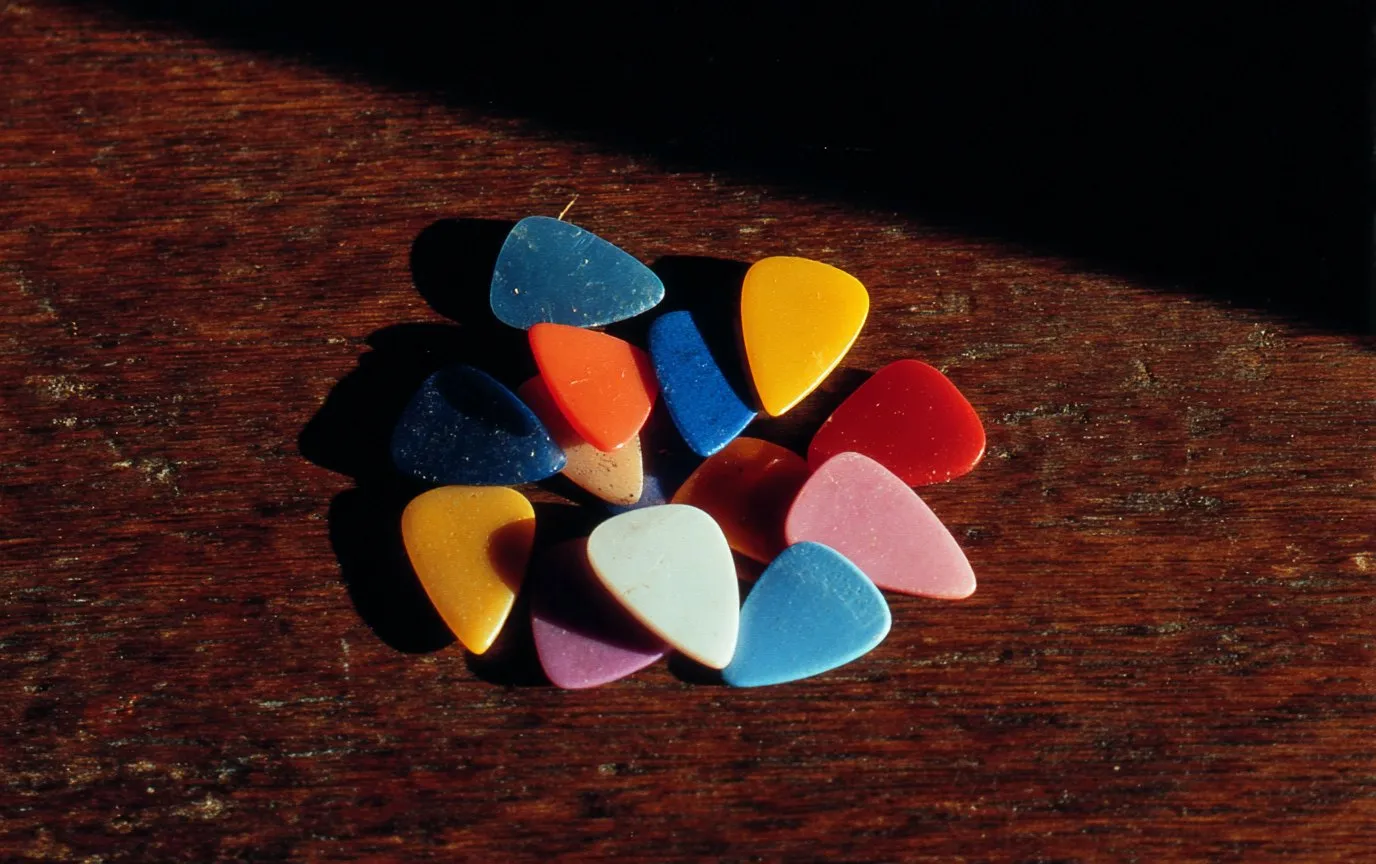
Irish tenor banjo picks: thickness, grip and triplets
Start by comparing two nylon picks, such as 0.46 and 0.60 mm, on the same short phrase. Keep the shape, tempo and exposed tip similar. Choose the one that gives you an even sound with a relaxed grip.