Is the banjo Irish?
No. The banjo is West African, and it reached Ireland in 1844 with a touring American blackface minstrel troupe. It took another hundred and twenty years to become the instrument you hear in a session. That is a better story than the one people expect.
By TradTabPublished
- Short answer
- No. The banjo is West African in origin
- Closest ancestor
- The akonting, a Jola gourd lute from the Gambia
- Reached Ireland
- 1844, with a touring American minstrel troupe
- The tenor banjo arrived
- Early 1900s, through dance bands and jazz
- First Irish recording
- 1916, James Wheeler
- Became a tune instrument
- Late 1920s, and standard in the 1960s
Where does the banjo actually come from?
West Africa. The banjo is descended from a family of plucked gourd lutes, of which more than sixty distinct types are found across the region, and it reached the Americas in the memories of enslaved Africans rather than in their luggage. Almost nobody could carry an instrument. They rebuilt them from memory.
The closest known relative is the akonting, a three-stringed lute of the Jola people of the Gambia: a long neck, a body made from a calabash gourd, a goat skin stretched over it, and a short thumb string that is not fretted. Players on both sides of the Atlantic have remarked on how alike the building and the playing are.
What emerged in the Caribbean and colonial North America was the gourd banjo: gourd body, hide head, fretless neck, a bridge that floats on the skin rather than being fixed, and that short thumb string carried over intact. From the earliest references in the seventeenth century through to the 1830s the banjo was an African American instrument with a West African heritage, and nothing else.
That short thumb string is the ancestor of the fifth string on a modern 5-string banjo, which still sits at the fifth fret with its own peg and still drones. It is the oldest thing on the instrument.
How did the banjo get to Ireland?
On tour, in 1844. The Virginia Minstrels, an American troupe who had staged the first full minstrel show in New York on 6 February 1843, crossed to Ireland the following year and played Dublin, Cork and Belfast. Their line-up was banjo, fiddle, bones and tambourine.
What they brought was a fretless five-string, and it arrived as an accompaniment instrument rather than a melody one. Irish musicians who picked it up over the following decades used it to back singing and dancing, which is what it had been doing on stage.
Fretted banjos followed from the late 1870s, and that mattered more than it sounds: frets put every note in tune for you, which is what eventually made the instrument usable for fast melody by players who had learned by ear.
When did the tenor banjo arrive?
The early 1900s, and it was not designed for Irish music at all. The four-string tenor grew out of the eight-string banjolin, first drawn up in 1885 by John Farris of Hartford, Connecticut, and by the early twentieth century the four-string tenor was the mainstream instrument. It was built for dance bands and for jazz, where it had to cut through a room full of horns.
It reached Irish music through those same dance bands, not through the tradition. The first Irish tenor banjo on record is James Wheeler in 1916, accompanying the button accordion player Eddie Herborn on what is the earliest disc of Irish traditional music.
Note what he was doing on it: accompanying. For its first decade in this music the tenor banjo was still a rhythm instrument.
When did it start playing tunes?
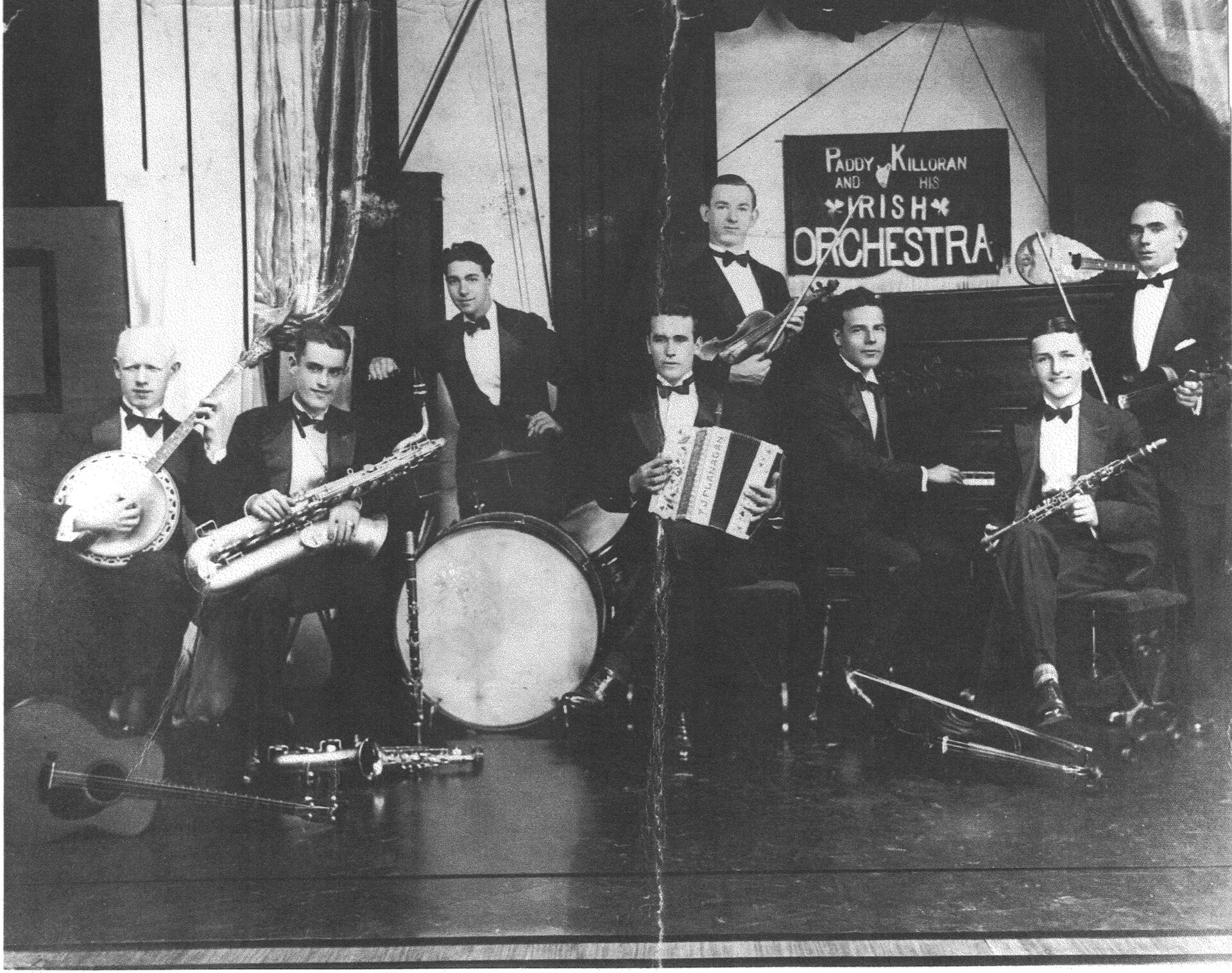
The late 1920s, in the hands of Irish-American recording musicians. Players began picking out jigs and reels with ornamentation instead of strumming behind somebody else, and the Flanagan Brothers are the clearest example: Mike Flanagan took the melodic line while Joe and Lou played underneath him. Neil Nolan, Michael Gaffney and Bill Whelan were all playing tenor banjo before the Second World War.
Then the 1960s folk revival made it ordinary. Barney McKenna of The Dubliners is credited with establishing GDAE as the tuning, which is fiddle tuning an octave lower, and that single decision is what made the instrument fit the music properly. Tunes fall under your fingers in the shape a fiddler already plays them.
From a fretless five-string carried into Dublin by a blackface troupe in 1844, to a 19-fret four-string playing reels in GDAE, is about a hundred and twenty years.
- 17th century onwardGourd banjos in the Americas
Built from West African memory by enslaved Africans. Gourd body, skin head, fretless neck, a floating bridge and a short thumb string.
- 6 February 1843The first minstrel show
The Virginia Minstrels stage it at the Bowery Amphitheatre in New York. Banjo, fiddle, bones, tambourine.
- 1844The banjo lands in Ireland
The same troupe tours Dublin, Cork and Belfast. Fretless five-string, used for accompaniment.
- Late 1870sFrets arrive
Fretted banjos start being used in Irish music. The note is now either right or you are on the wrong fret.
- 1885 to early 1900sThe four-string tenor appears
Grown out of John Farris’s banjolin designs and built for dance bands and jazz, not for this music.
- 1916First Irish tenor banjo recording
James Wheeler accompanies Eddie Herborn on the earliest disc of Irish traditional music. Still accompaniment.
- Late 1920sIt starts playing the tunes
The Flanagan Brothers and their contemporaries pick out jigs and reels with ornaments instead of strumming behind them.
- 1960sGDAE, and it becomes ordinary
Barney McKenna establishes fiddle tuning an octave down, and the folk revival makes the tenor banjo a mainstream tune instrument.
So is it an Irish instrument now?
Yes, in every sense that matters, and no in the sense people usually mean. It is not ancient here and it is not native here. It has been played in Irish music for roughly a hundred and eighty years and playing tunes for about a hundred, which is longer than the button accordion has been in widespread use and about as long as anyone alive can remember.
A tradition is not a list of objects. It is what people do, and Irish musicians have done something with this instrument that nobody else does: tuned it in fifths to match a fiddle, played single-line melody on it at speed with a plectrum, and built an ornament vocabulary around the triplet that exists nowhere else in banjo playing.
The honest answer to somebody asking whether the banjo is Irish is that the instrument is West African, the route was American, and what is done with it here is Irish.
Questions about where the banjo came from
No. The banjo is West African in origin, descended from gourd lutes such as the akonting, and it was developed into its modern form by enslaved Africans and their descendants in the Americas. It reached Ireland in 1844 with a touring American minstrel troupe and became an Irish traditional instrument over the following century.
West Africa gave it its ancestors, and the banjo itself took shape in the Caribbean and colonial North America among enslaved Africans, who rebuilt remembered instruments from a gourd, a hide and a fretless neck. More than sixty types of plucked gourd lute exist across West Africa, and the closest relative is the akonting of the Jola people of the Gambia.
1844. The Virginia Minstrels, an American blackface troupe who had staged the first minstrel show in New York in February 1843, toured Dublin, Cork and Belfast the following year. The instrument they brought was a fretless five-string, used for accompaniment rather than melody.
The four-string tenor reached Irish music in the early 1900s through dance bands and jazz. The first Irish tenor banjo on record is James Wheeler in 1916, accompanying Eddie Herborn on the earliest disc of Irish traditional music. Players only began picking out tunes on it in the late 1920s.
Because the tenor arrived through dance bands as a plectrum instrument playing single lines, which is what Irish traditional music is, and because Barney McKenna established GDAE tuning in the 1960s. GDAE is fiddle tuning an octave lower, so tunes sit under your fingers the way a fiddler already plays them.
It is now, by any working definition. It has been in Irish music for about a hundred and eighty years and carrying melody for about a hundred, and Irish players have built a technique around it, the plectrum triplet above all, that exists nowhere else in banjo playing. It is not native and it is not ancient here, and neither is the button accordion.
A three-stringed lute of the Jola people of the Gambia, and the closest known relative of the banjo. It has a long neck, a body made from a calabash gourd with a goat skin over it, and a short thumb string that is not fretted, which is the ancestor of the fifth string on a 5-string banjo.
That is how it crossed the Atlantic to Ireland, yes. The Virginia Minstrels performed in blackface and advertised a repertoire of "negro melodies", which was a caricature of the African American musicians who created the instrument. The banjo itself long predates minstrelsy; the minstrel show is how it travelled, not where it began.
Keep reading
 Read the guide
How many strings does a banjo have?
Five, usually. Four if it is a tenor or a plectrum banjo, and six exists. For playing Irish tunes you want four. The two common banjos are built for different jobs and the fifth string is the reason, and The Dubliners carried one of each, which is the clearest answer anybody has given.
 Read the guide
Is the Irish tenor banjo hard to learn?
Easier than the fiddle, harder than it looks on YouTube. The notes come quickly and the right hand takes years. Here is an honest account of what is actually difficult, what is easier than people expect, and how long it takes to be useful at a session.
Read the guideFive easy Irish tunes for tenor banjo, in learning order
Begin with a repeated phrase, then add jig rhythm, string crossings and longer runs. Each tune below links to one specific setting, with a skill to practise and a phrase to watch.